Slant Headstones: Design, Materials, Cost and Installation
Reviewed by Arslan Hajiyev, Founder of H Memorial Group
What is a slant headstone?
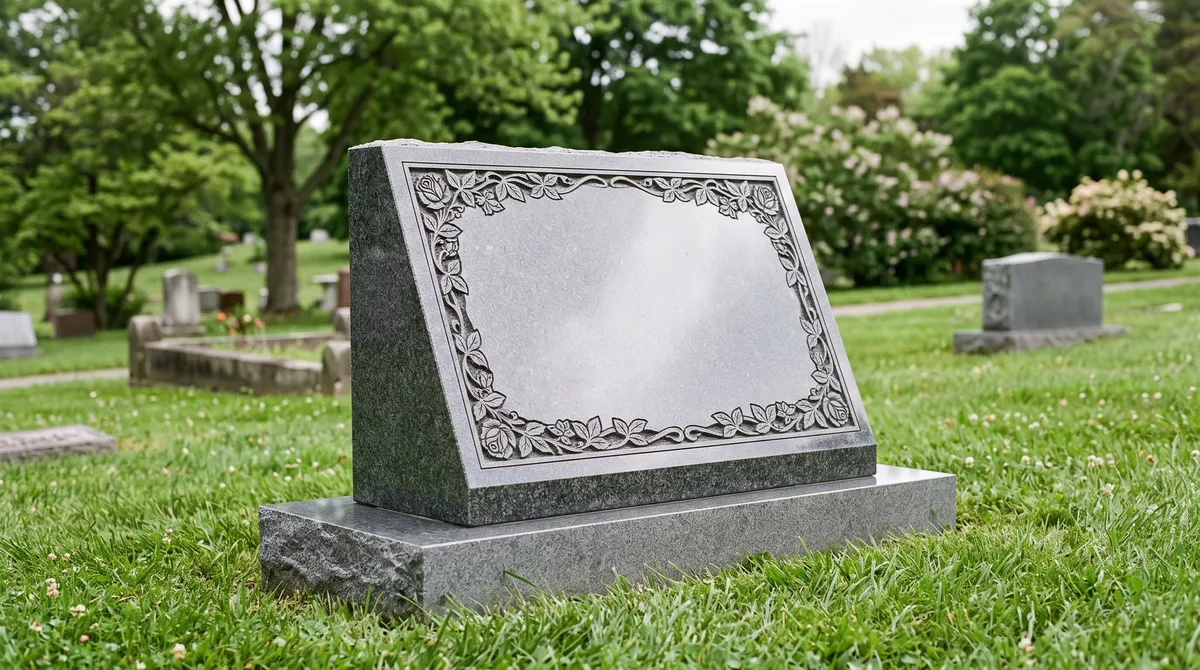
A slant headstone (also called a slant marker or slant monument) has a vertical back and an angled front face that carries the inscription. It is usually mounted on a separate granite base set on a concrete foundation. The angled face catches light and stays readable from a standing position.
How does a slant compare with bevel and upright headstones?
| Profile | Height | Where it fits |
|---|---|---|
| Bevel | A few inches at the back. | Sections that allow only low markers. |
| Slant | Taller than a bevel, lower than an upright. | Sections that allow raised memorials but limit height. |
| Upright | The tallest standard profile. | Traditional sections; most room for artwork. |
For low profiles, read our flat headstones guide; for every style, see the 12 types of headstones.
Which slant headstone designs are available?
- Luxury Portrait Slant Granite Headstone — from $3,285.53, with space for an etched portrait.
- Luxury Slant Granite Headstone with Sculpted Vine & Cross — from $3,947.08.
- Luxury Slant Granite Headstone with Rock-Pitched Edge, Rose Motif & Vase — from $6,581.16.
- Luxury Slant Granite Headstone with Hummingbird & Lily Panel & Vase — from $6,581.16.
Which granite and finishes suit a slant headstone?
All 4 slant designs are offered in 9 granite colors. A polished face gives the strongest contrast for lettering, while a rock-pitched edge — the hand-split, natural-looking border on the sides — frames the polished face with texture. Dark, even granite is the best choice for a laser-etched portrait. Compare colors in our granite color guide.
What can be engraved on a slant headstone?
The sloped face holds one or two names, dates, an epitaph and artwork such as roses, crosses, hummingbirds or lilies. Some designs add a vase on the base. Every layout is checked on a design proof before production — our inscription guide covers wording and engraving methods.
How is a slant headstone installed?
- The cemetery approves the memorial application and confirms its foundation rules.
- A concrete foundation is prepared to the cemetery’s specification.
- The base is set on the foundation and the slant is set and secured on the base.
Installation through Monument Service Group or another qualified provider is quoted separately and scheduled after cemetery approval; cemetery and permit fees are not included. Our installation guide explains each step.
What does a slant headstone cost?
Slant designs start from $3,285.53 to $6,581.16 in our 2026 catalog. The final price depends on size, granite color, artwork and options. Taxes, cemetery fees, foundation and installation are separate; complimentary delivery may apply to eligible orders within the 48 contiguous states. See the 2026 price guide and current offers.
How do I order a slant headstone?
Open a design in the slant collection, then request a quote with your cemetery name or call +1 888 248 6813. Production begins only after final written design approval and cemetery approval where required.
Ready to design a headstone?
Get a free, no-obligation quote with a custom 3D design preview, or browse our catalog of 100+ granite headstones. Call +1 888 248 6813.
Related headstone guides
- Headstone TypesColumbariums and Cremation Memorials: A 2026 Family GuideWhat a columbarium is, how niches, columbarium benches and urn burial compare, what cemeteries and churches require, and how to plan a granite cremation memorial.
- Headstone TypesFlat Headstones: Types, Designs, Prices and Cemetery RulesWhat a flat headstone is, how it differs from bevel and slant markers, which cemeteries require one, and what our flat granite designs cost in 2026.
- Headstone TypesDouble Headstones for Couples: Companion Monument GuideHow double (companion) headstones work for husband and wife, upright, flat, bench and heart designs, how to plan the second date, and 2026 prices.