Installation day for a six-foot granite cross runs on a choreography most families never see. The crane arrives before the family does. The foundation - poured weeks earlier, cured and checked level - waits under a lifting frame, and the shaft comes off the truck in padded slings, seven hundred pounds of carved stone swinging gently against a morning sky. Stainless dowels find their sockets. The crew reads the level twice, then a third time, because a cross reads plumb from every direction or it reads wrong from all of them. And then the straps come off, the machinery goes quiet, and something that was cargo an hour ago is suddenly, unmistakably, a monument - vertical, permanent, doing the one thing crosses have done on graves for seventeen centuries, which is to stand.
Remembrance Headstones builds cross work at every scale across fourteen locations in eight states, but this article is written from the monumental end of the bench, where the cross is not an emblem on the stone but the stone itself - shaped, sculpted, gilded, engineered. The engraved cross gets its due here too, handled the way this studio handles it. Mostly, though, this is about the vertical work: what it takes to carve, raise, and keep standing the boldest form the memorial trade owns.
Cross Headstones as the Studio's Oldest Carving Discipline
Every monument shop can sandblast a cross onto a tablet. Shaped cross headstones - the freestanding form, shaft and arms and base cut as sculpture - belong to a smaller trade within the trade, and this studio keeps that discipline alive on purpose. The work begins in the drawing stage with proportions the old carvers codified: the arms crossing above the shaft's midpoint, the taper that keeps a tall cross from reading heavy, the base stepped once or twice so the eye climbs. Then the stone. A monumental cross wants granite with quiet grain, because busy stone fights the silhouette, and the studio selects blocks for these commissions the way a sculptor would - which is what the commission is.
Cross headstones at this scale range from the four-foot family pieces that anchor a double plot to the towering forms that own a hillside, and the price follows the carving hours more than the height. What the family receives for those hours is the thing no engraved emblem delivers: a monument legible from the road, in silhouette, before a single letter can be read. Some families need exactly that legibility. They tend to know it walking in.
Headstones with Crosses in Relief and the Corpus Carver's Art
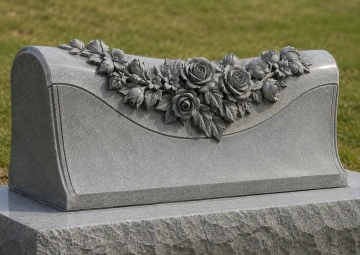
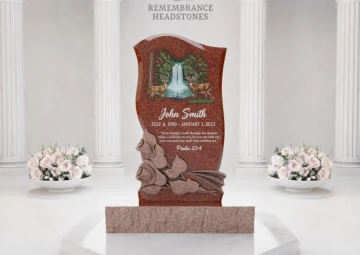
Between the engraved emblem and the freestanding form lives the studio's relief work, and it deserves its own chapter because it is where the carving hand shows most. Headstones with crosses in raised relief lift the form off the tablet's face - the background cut away, the cross standing proud, throwing true shadow that moves through the day. Draped crosses, the Victorian mourning form of a carved cloth falling across the arms, come out of this bench; so do crosses wrapped in relief-carved roses and ivy, the stone flora undercut until it seems ready to move.
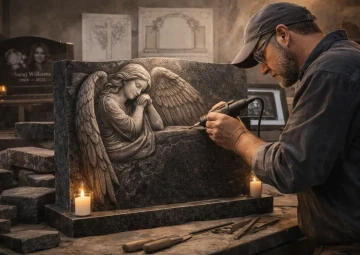
The summit of the discipline is the corpus - the crucifix bearing the figure of Christ, carved for Catholic families in relief or fully in the round. Corpus work is figurative sculpture, drawn from multiple angles, revised with the family, and executed by carvers whose training was measured in years, and this studio treats those commissions with the reverence and the review they demand. A headstone with cross work at this level stops being a category purchase entirely. Families commissioning a corpus almost always bring a reference - the crucifix from the home parish, a grandmother's - and matching that reference faithfully is the entire brief. We have carved from photographs of church walls in Guadalajara and Kraków. The parish never knows. The family always does.
A Cross on Headstone Faces and When the Emblem Is Enough
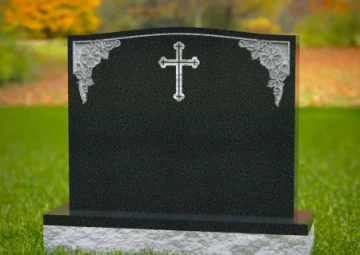
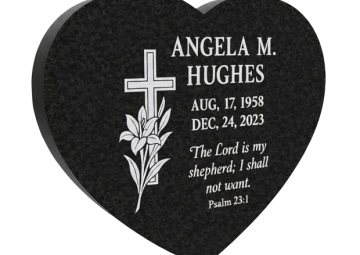
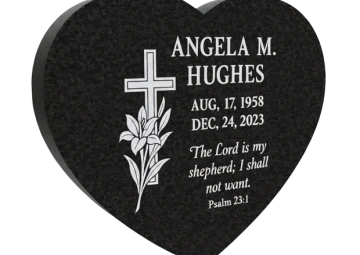
Honesty about the quieter option, because it is right for many families and the studio says so. A cross on headstone faces - engraved, frosted, or etched into a conventional tablet - satisfies most cemetery rulebooks, leaves the full face free for names and verse, and costs little beyond the monument itself. Headstones with crosses rendered this way remain the majority of what any cemetery holds, and rightly. Placement follows old conventions: crowning the name top-center, presiding from a corner beside a portrait, or running nearly the tablet's height with the inscription set within its arms. Depth is the design lever - a shallow etched cross whispers, a deep V-cut one carries to the path - and the studio cuts all of it daily.
The counsel our designers give is simply proportional: let the cross's prominence match the faith's place in the life. For the woman whose church was her whole calendar, the vertical work of this article's other chapters exists. For the man whose faith was real and private, an emblem in the corner tells the truth. Both are correct, and a studio confident in its monumental work has no need to upsell anyone out of the honest emblem.
Celtic Cross Headstones and Knotwork as Commissioned Craft
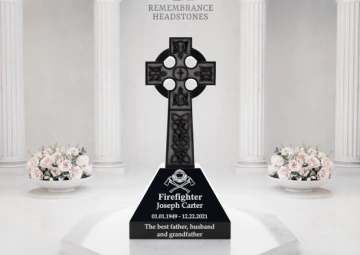
The ringed cross gets the full artisan treatment here, because celtic cross headstones are where carving skill is most visible and most often faked. The great medieval high crosses of Ireland and Scotland - the ancestors of every ringed cross in American cemeteries - were carved edge to edge with interlace, and the interlace was the point: pattern as devotion, complexity as offering. Modern shortcuts exist. Clip-art knotwork, blasted shallow, reads as decoration from ten feet and as disappointment from two.
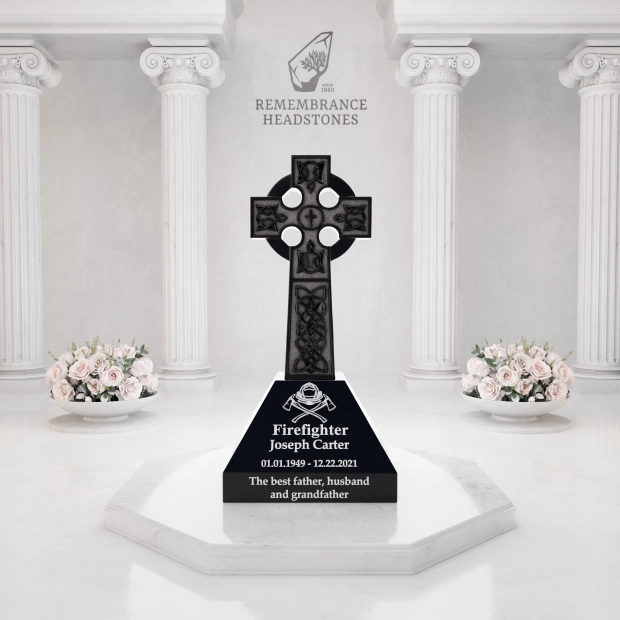
This studio's Celtic commissions run the older way. The knotwork is drawn for the specific stone - Trinity knots, endless plaits, spiral bosses composed to the shaft's proportions - then carved deep enough to hold shadow, so the pattern reads at distance the way the originals still do after twelve centuries of weather. A celtic cross headstone from this bench takes real hours, and families adding a clan motto to the base, a harp or thistle worked into the interlace, or knotwork matched from a photograph of an ancestral stone in Mayo or Argyll add hours the quote states plainly. What the hours buy is the difference between wearing heritage and printing it. One Tukwila commission carried knotwork a daughter traced from her great-grandmother's grave in Ireland; the pattern crossed an ocean, and our carvers made sure it lost nothing in the crossing. Celtic cross headstones done to that standard become the stone the whole cemetery section is known by. We have watched it happen more than once.
Black Granite Cross Headstone Work and the Gilded Cross
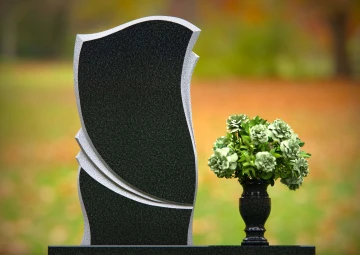
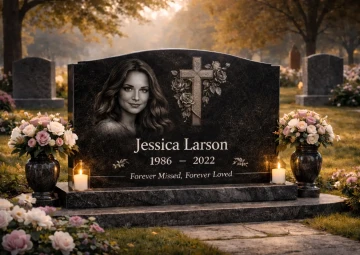
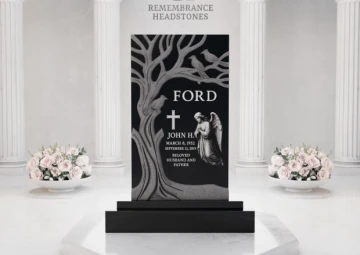
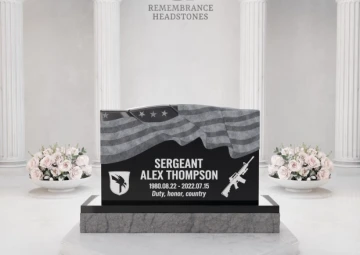
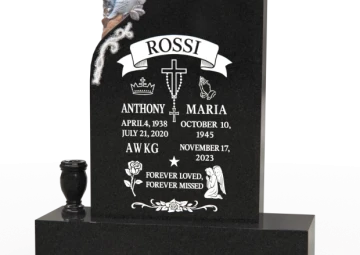
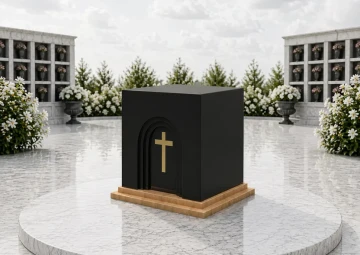
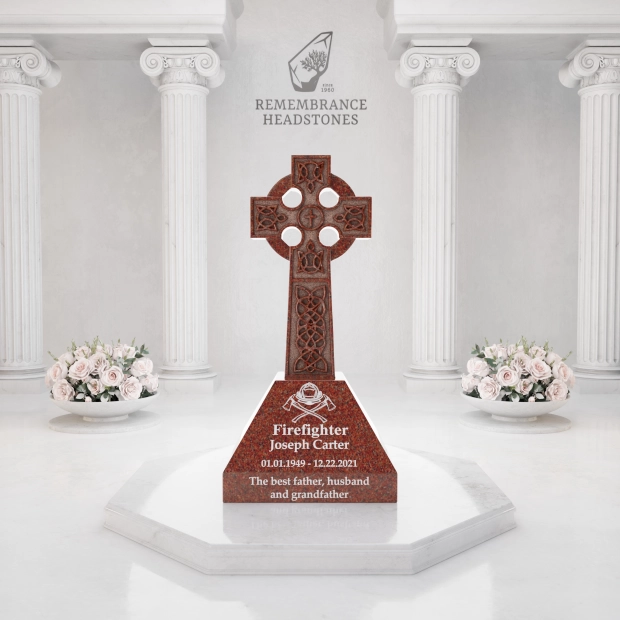
Color and light, briefly, because dark stone changes the vertical form's whole character. A black granite cross headstone carries its polish along the full silhouette, so the monument reads almost as cast metal at distance - severe, modern, and striking in a way gray never attempts. Etched and frosted detail thrives on the dark faces: fine knotwork, a verse along the shaft, a portrait set into the base panel. The studio's Jet Black and deep Indian stocks take this work best, and the maintenance honesty comes free with the consultation - black shows pollen and water spots between cleanings, and no family has ever changed their mind over it, but every family deserves to hear it.
Gilding crowns the palette. Gold leaf worked into a cross's incised borders, into the lettering along its base, or - in the Orthodox commissions our Sacramento and Roseland studios carve steadily - across the three-bar form itself, following the tradition's own churches. A gilded cross against black granite is the most luminous object this trade produces, and the studio spends the leaf accordingly: deliberately, where the design earns it, quoted by the hour and the karat in the proof.
Granite Cross Headstone Engineering Nobody Sees
Now the chapter the brochures skip. A tall cross is a structure before it is a symbol, and a granite cross headstone stands for centuries only because of decisions buried at installation. Wind load governs the engineering - a six-foot shaft presents real sail area in an open cemetery, and the answers are mass, mechanical connection, and foundation. The studio's monumental crosses join shaft to base with stainless steel dowels set in structural epoxy, never adhesive alone; bases sit on poured foundations sized to the monument's footprint and the region's frost depth, because Illinois ground heaves and Florida ground shifts and both are solvable problems if somebody solves them before the crane arrives.
Our installation crews carry the checklists: plumb verified from two axes, joints weeped so water escapes rather than freezes inside them, the base's bearing checked against the soil report where the monument's size warrants one. None of this is visible on dedication day. All of it is why the cross is still plumb when the grandchildren bring their grandchildren, and a studio that carves at this scale without engineering at this scale is selling families a future repair. Ask any monument house one question before commissioning vertical work: tell me about the foundation. The answer tells you everything else.
Granite Cross Headstones Anchoring Family Estates
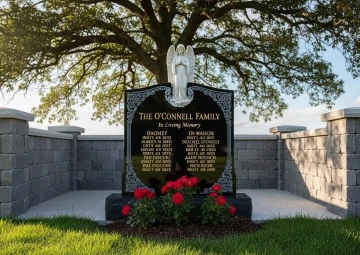
At the estate tier, the cross takes the role it has held in sacred architecture forever: the center. Granite cross headstones anchor family plots the way a steeple anchors a town - the monumental cross rising from the plot's heart, the family surname on its base, individual markers arranged around it, memorial enclosures and railings framing the ground, landscaping composed in the studio's drawings so the plantings frame the silhouette rather than crowd it. The composition is old, visible in the finest sections of every historic cemetery from Philadelphia to Sacramento, and this studio builds it complete: cross, markers, enclosure, ground, one design.
Estate cross commissions are pre-need work more often than not - a family patriarch or matriarch deciding, calmly, what the family's center will look like - and the reserved granite lot guarantees that markers added across future decades match the cross they gather around. The cross at the center of an estate does something subtle to how the plot is used: it gives every visit a focal point, every photograph a spine, every generation the same landmark. Families report that the plot becomes where the reunion ends. The cross was always going to be the reason. That is rather its specialty.
Cross Designs for Headstones in the Heritage Traditions
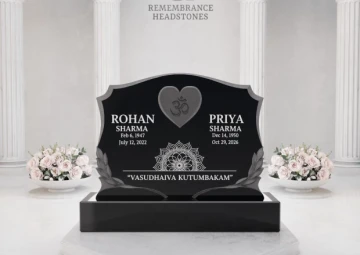
The form's vocabulary spans every community this studio serves, and cross designs for headstones are chosen by heritage as often as by taste. The Orthodox three-bar cross with its slanted footrest, carved and gilded for Russian, Ukrainian, Serbian, and Greek families, lettered in Cyrillic where the tradition asks. The Latin cross plain and eternal, the trade's default for a reason. The crucifix with corpus for Catholic commissions, the budded cross with trefoil ends for the Methodist and Baptist heartland, the Guadalupe compositions where the cross and the Virgin share the face for the Mexican-American families of our Texas and California regions. The draped mourning cross revived from the Victorian pattern books for families who love the old sections' language. And the Celtic ring, covered above, carrying two nations' worth of memory in one silhouette.
Our designers ask about heritage early because the answer usually decides the form before taste enters, and because rendering a tradition's cross incorrectly is worse than rendering none. The reference photographs families bring - the church, the ancestor's stone, the icon corner - are treated as design documents. Getting the family's own cross exactly right is not a premium service here. It is the minimum standard of the category.
Cross Headstones for Graves Under Height Rules
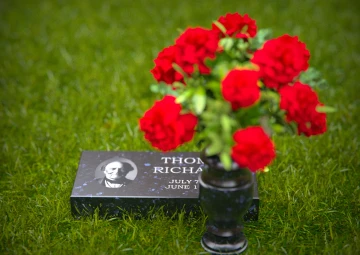
The regulatory chapter, condensed to what decides commissions. Cross headstones for graves meet three recurring constraints: height caps, common at four feet or so, which turn a monumental ambition into a cross-topped tablet or a relief composition; flat-only sections, which move the cross into deep-cut engraving on polished stone - where it loses less presence than families fear; and religious-section conventions governing which forms belong where. Our team verifies the specific cemetery's rules before any drawing is finalized, prepares the approval paperwork, and - where a beloved design and a rulebook genuinely conflict - redesigns on paper at no cost rather than negotiating at the gate.
The practical sequence for families set on vertical work: bring us the cemetery's name first. The rulebook chooses the category; the family chooses everything inside it; and a studio that reads the rules before it draws never has to un-carve anything. In eight states of rulebooks, that sequence has not failed yet.
Cross Headstone Engraving Designs Previewed at True Scale
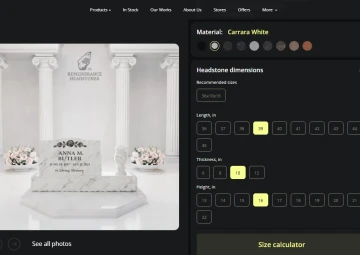
Every decision in this article rehearses at full size before stone is touched. The configurator on each product page at remembranceheadstones.com builds the design live - shaped cross or engraved emblem, granite color, knotwork, lettering, gilding - rendered in 3D, and the AR preview stands the finished monument on the plot through a phone screen at true scale, where a six-foot silhouette either belongs to its setting or asks to be five and a half. Vertical work benefits from the preview more than anything else the studio sells; height is the one dimension no photograph communicates, and families adjust it at the AR stage constantly, cheaply, permanently regret-free. Cross headstone engraving designs on the tablet side preview the same way, down to the depth rendering that shows how the V-cut will shadow.
The studio proof follows free with two revisions, and the commission terms carry the rest: 10% off with full payment, 20% for veterans and 15% for first responders paying in full, Klarna and Affirm to 24 months, 0% in-house plans to 12, pre-need to 36 months interest-free with free storage - and through July 31, 25% off two or more monuments with full payment, which estate cross compositions meet by their nature. The showrooms from Sacramento to Essington to Orlando keep shaped and relief crosses on the floor. Stand next to one. Vertical work makes its own argument at about the second step back, and it has been making it, successfully, for seventeen hundred years.