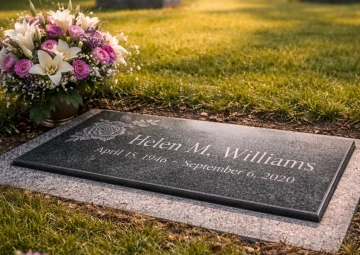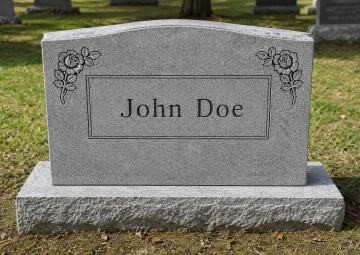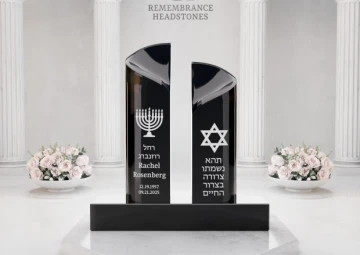
Three things about a Jewish burial confuse anybody without knowledge of the tradition: the piled stones on the grave, the headstone appearing a year after the burial rather than immediately, and the Hebrew.
Each has a straightforward explanation, and all three are worth knowing before attending an unveiling or arranging a memorial.
Why Do You Put Stones on Jewish Graves
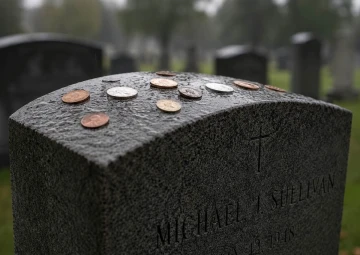
The custom is to place a small stone rather than flowers on a Jewish gravestone. It is the most noticeable feature in any Jewish cemetery and the most frequently asked about.
There is no single official reason, and several explanations coexist.
The practical origin. In ancient times graves were marked with cairns of piled stones, both to identify the burial and to protect it. Adding a stone maintained the marker.
Ritual purity. Kohanim, those of priestly descent, were forbidden to come into contact with a grave. Rocks on Jewish graves marked clearly where they should not walk, and adding to the pile was a service to the community. The custom outlived the purpose.
Permanence. The explanation most often given today and the one families find most meaningful. Flowers wilt. Stones do not. Leaving something that lasts is a truer statement about memory.
The word itself. In Hebrew, tzror means both a pebble and a bond. The phrase tzror hachaim, bound in the bond of life, appears at the end of most Jewish inscriptions. Leaving a pebble is the physical version of that phrase.
Practically: any stone will do, picked up from the ground nearby or brought from somewhere meaningful. There is no rule about size or type, and Jewish tombstone rocks are not sold anywhere for the purpose. Place it on the top of the marker or on the base. That is the whole custom. Jewish grave rocks left this way are never cleared away.
The Unveiling Ceremony
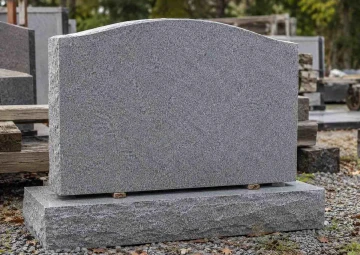
Unlike other traditions, Jewish headstones are not set immediately after burial. The dedication is a separate ceremony held around eleven or twelve months after the death, though some communities hold it sooner. The first year is the period of mourning, and setting the stone marks its close.
A temporary marker records the burial during that period.
The ceremony is short, typically fifteen to thirty minutes. A cloth covering the stone is removed, psalms are read, most often Psalm 23 and Psalm 121, a brief eulogy may be given, and the mourner's kaddish is said if ten adults are present.
It takes place at the graveside in whatever weather. Families frequently follow it with a meal.
A rabbi is not required. Any family member can lead it, and many do.
From a practical point of view, the thing a monument company has to watch is the schedule. The stone must be finished and set before the date, and northern cemeteries that stop setting over winter can complicate a spring unveiling. Order at least three months out.
Jewish Grave Unveiling Dress Code
The question comes up constantly and the answer is simple. What do you wear to a Jewish grave unveiling, in short: dress as you would for a synagogue service.
Dark or muted colours, modest, nothing casual. It is not a funeral so full black is not required, but it is not an occasion for bright clothing either.
Men cover their heads. A kippah is worn and one will usually be provided. Non-Jewish male guests wear one too; it is a mark of respect and nobody will object.
Women in Orthodox settings may cover their heads, and married women usually do. In Conservative and Reform settings it is generally not expected. If unsure, bring something and follow what others do.
Shoulders and knees covered is the safe standard for everybody.
Practical footwear. It is a cemetery, outdoors, on uneven grass. Heels sink.
Bring a small stone, or pick one up there, and place it on the marker before leaving.
Jewish Headstone Inscriptions and What They Say
A Jewish tombstone follows a recognisable structure, and knowing it makes any Jewish cemetery legible.
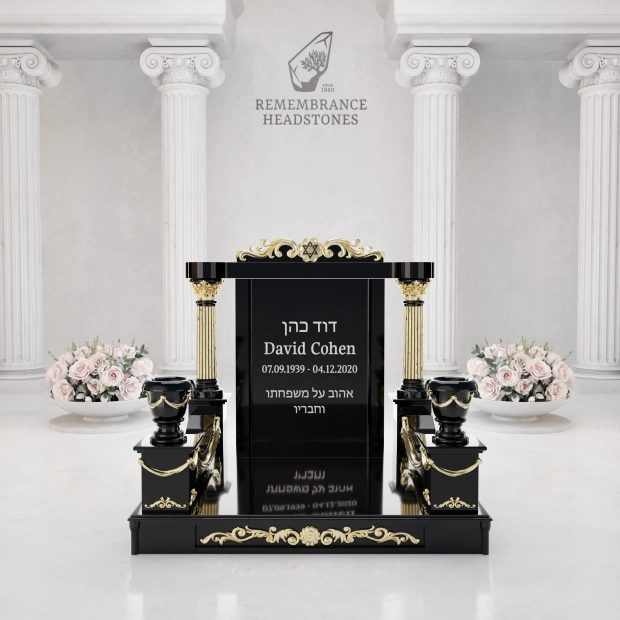
פ״נ at the top. Two Hebrew letters abbreviating po nikbar or po nitman, here lies buried.
The Hebrew name. Given name followed by ben, son of, or bat, daughter of, and the father's name. This is the ritual name and it may differ entirely from the English one.
The English name and civil dates, usually below.
The Hebrew date of death, given by day, month and year in the Hebrew calendar. It frequently will not correspond to the civil date in the obvious way, because the Hebrew day begins at sunset.
תנצב״ה at the foot. Five letters abbreviating t'hei nishmato tzrurah bitzror hachaim, may his soul be bound in the bond of life. This is the most common of all Jewish tombstone inscriptions.
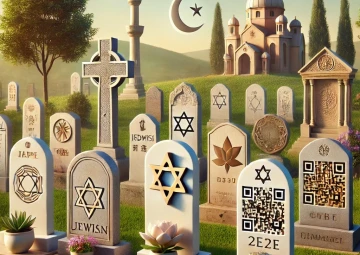
Symbols, where relevant. A Star of David. Hands raised in the priestly blessing, indicating descent from the Kohanim. A pitcher and basin, indicating a Levite. A menorah, frequently on a woman's stone. Books for a scholar.
Making Sure the Hebrew Is Right
This is where mistakes happen, and they are permanent.
Get the Hebrew name from the family or the synagogue. It is not derived from the English name and it cannot be guessed. A man called Bernard may have been Baruch ben Yitzchak, and only the family or the congregation's records will know.
Confirm the Hebrew date with the rabbi or the burial society. Converting a civil date requires knowing whether the death occurred before or after sunset.
Have the proof read by somebody who reads Hebrew. Not the monument company, not a translation service, but somebody in the family or the congregation. Hebrew reads right to left and a letter error is invisible to anyone who does not read it.
Any competent monument company can cut Hebrew. Almost none can proofread it, and the honest ones say so.
Jewish Monuments and What Cemeteries Require
Most Jewish cemeteries favour restraint in monuments, and the rules reflect it.
Upright stones are standard in most Jewish cemeteries, unlike the flat-marker memorial parks common elsewhere.
Photographs are permitted in some communities and discouraged or prohibited in others. Sephardic and Eastern European traditions differ, and practice varies considerably by congregation.
Simplicity is the convention. Figurative sculpture is rare, partly because of the prohibition on graven images, though decorative carving and symbols are entirely normal.
Consistency within a section is often enforced. Some cemeteries specify granite colour or maximum dimensions so the section reads uniformly.
Burial societies attached to a congregation frequently have rules on top of the cemetery's, and they are the body to ask.
The general advice: ask the cemetery and the congregation before designing anything. Both may have requirements and they do not always match.
Marking a Jewish Grave That Has Waited
A situation that arises more often than people think. A family discovers a relative buried decades ago whose grave was never marked, usually because the money was not there at the time.
Marking it now is straightforward and it is considered a genuine act of respect. The Hebrew name can usually be recovered from the burial society, the cemetery register or the congregational archive, and the date of death from the same sources.
There is no time limit on this and nothing improper about doing it seventy years late.